How Can Graphic Design Be Related to Fine Art
Art historians explore and analyze the influences of times and cultures upon artists, sculptors, and architects. Such influences of individual artists or artistic "schools," "movements," or "styles" upon their contemporaries and on those who come up after them loom large in this arena.
Graphic Design, being a visual art, too has a rich history of influences. These influences come not merely from previous designers and the cultural milieu in general, simply also from the fine arts. The standard distinction that is fatigued between the graphic arts and the fine arts boils down to intention. For the graphic arts (or "commercial art," as it used to be chosen) that intention is fundamentally in the service of commerce, i.due east. for communicating about businesses or organizations with promotional or monetary gain every bit its goal. By contrast, the fine arts are at heart an individual, personal expression of the artist that is not intended to sell or promote whatsoever third party product or service. And so the graphic arts are viewed more as a craft, a handmaiden to commerce, while the fine arts are seen as an elevated, completely unique and pure expressions of inventiveness, whether the products of that inventiveness are offered for auction or non.
You lot may be surprised to acquire that the thought of the artist working as an independent creative entity, making fine art solely and purely every bit personal expression (essentially "fine art for fine art'south sake" — the phrase itself originating in the early 19th century) is a relatively recent evolution in the overall history of western art. The concept of the artist creating personally expressive works for the purpose of exhibiting and/or selling them is a decidedly post-Renaissance phenomenon.
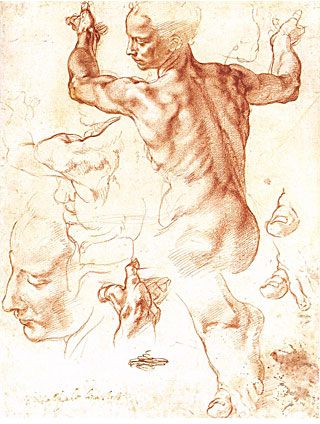
Michelangelo Buonarroti
Report for the Libyan Sibyl
Sistine Chapel – 1508-ten
Arguably it was not until the late 17th century that artists began to be sought out primarily for their individual works, their style, or their fame. Artists had begun to offering mural, yet life and genre paintings to the rising merchant classes, and such works began to be the source of artists' incomes. Prior to this, artists were engaged or commissioned by their patrons, guilds, or municipalities for very specific purposes, such equally the decoration of the homes of the aristocracy, or equally donations to churches, banners, or portraiture that would enhance the reputation and serve the needs of the patron rather than of the artist. Artists were treated equally tradesmen or craftspeople with a particular skill. Major commissioned works of the Renaissance served the purposes of the patron, not the painter, sculptor, or architect. The likes of Leonardo DaVinci (1452 – 1519) and Michelangelo Buonarroti (1475 – 1564) did mutter about the vagaries of their patrons regarding both the commissions they were awarded (or non) and the payment they received (or not!)
Artists working before the 17th century were sought-afterward and had great fame in their own times, simply neither had a "marketplace," nor were they asked to produce a work of fine art as a purely personal expression of their own individual creativity. Yet — interestingly — today no ane would dispute the categorization of works produced prior to that time as "fine art."
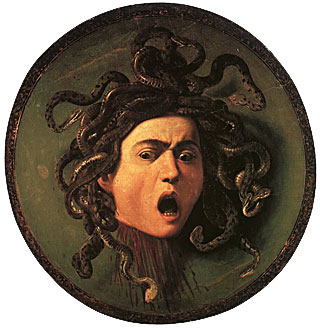
Michelangelo Merisi da Caravaggio
Testa di Medusa
c. 1597 (Uffizi version)
A 16th century example of a work of art that today we would consider that of an undisputed fine artist is the Testa di Medusa, dated 1597. It is a parade shield commissioned of Michelangelo Merisi di Caravaggio (1571 – 1610) by patron Key Francesco Maria Bourbon del Monte as a gift for Ferdinando I de'Medici, Grand Duke of Tuscany. This work is a painting in oil on canvass covering a round wooden panel and exists in two versions, i in the Uffizi and one in a individual drove. It is a archetype example of the creative person as craftsman, employed to create a work not as a personal artistic expression, but for a practical (admitting ceremonial) use and as a showpiece to symbolize the power of the K Duke's family unit. Artwork such as this was commissioned for carrying and display in a parade or civic outcome rather than every bit a piece of work of fine art to hang on a wall. Caravaggio was nothing if not a highly private and willful character, only he was clearly nevertheless considered as fundamentally a tradesman by his patron.

Paul Rand
Logo for IBM
1972
Today, few would deny that inventiveness is a key component of the practice of graphic design. Designers at the highest levels take been sought out and commissioned by clients on the strength of their private styles, the clients seeking non an anonymous production of the design procedure, but rather to acquire or partake of a given specific designer'due south fame and personal way for the sake of the promotion of their businesses. One case is the now more than 40 twelvemonth old design of the logo for IBM, which was specifically deputed of the undisputed luminary and main of graphic design of the 20th century: Paul Rand (1914 – 1996).
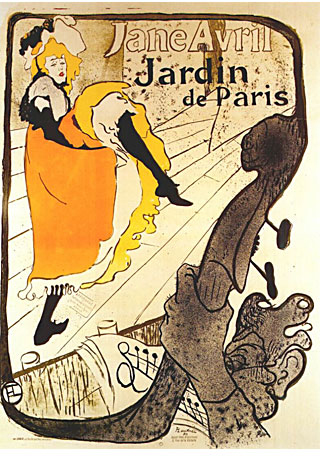
Henri de Toulouse-Lautrec
Affiche – Jane Avril, Jardin de Paris
1893
Many artists have straddled the split up between the graphic and fine arts. To name only a few: Henri de Toulouse-Lautrec (1864 – 1901) was a painter, just he as well produced posters, Andy Warhol (1928 – 1987) was an artist who took many a motif from the "mundane" world of product design, artist/activist Keith Haring's (1958 – 1990) distinctive work also served to promote causes and would be considered both fine and "graphic" fine art fifty-fifty though he himself said that he did not want to exist either an illustrator or a graphic designer.
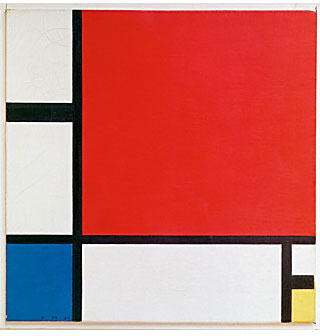
Piet Mondrian
Composition II in Ruby-red, Blue, and Yellow
1930
One (and just one out of many) of the most important direct influences of the fine arts on graphic blueprint is that of the Dutch painter and theoretician Piet Mondrian (1872 – 1944), who was both a contributor to and a participant in many of the seminal artistic movements of the offset one-half of the 20th century, virtually notably De Stijl and his own approach which he termed Neo-Plasticism. He is likewise associated with Color Field painting, Abstract Expressionism, and Minimalism. In his paintings, Mondrian rigorously explored the purest expression of abstruse (non-representational) compositional residue that was to exist had in two dimensions. There are few artists whose fashion has been more than "co-opted" by pop culture to the point of its influence on product, fashion blueprint, and fifty-fifty architecture. His echoes are seen everywhere.
Since most graphic design takes place in two dimensions, whether tactile or digital, compositional rest is a cardinal element of all graphic design. Circumscribed Mondrian's massive contributions to the expanse of graphic blueprint, today he is recognized equally the original inspiration for what came to be known among designers as the "Grid Arrangement." The seminal, though now transcended notion in the pattern world propounded an invisible filigree that would underly the structure and foundation of the page layout. There remains a nifty deal of influence of this concept not only in impress simply also in web blueprint. The grid forms a framework of columns and rows, merely these can be far from symmetrical or restrictive. To quote Josef Müller-Brockman (1914 – 1996), the Swiss graphic designer and author of Grid Systems in Graphic Blueprint, "The grid arrangement is an aid, not a guarantee. It permits a number of possible uses and each designer can wait for a solution appropriate to his personal mode. But ane must learn how to use the grid; information technology is an art that requires practice." Designers who are familiar with this concept seek to achieve Mondrian-like balance in their work. When a design is well-counterbalanced it has an extra quality to it that is perceived by the viewer, even if not consciously.
Skill in balanced composition is an art in and of itself, and by "balanced" nosotros frequently not exercise NOT mean but symmetrical. Artistic and powerful use of asymmetry, and of "negative" or "whitespace," or the counterbalanced interplay of the elements in a layout can "make or break" a pattern. The ability to etch at this level separates the merely informational from the compelling. Asymmetry is a compositional balancing act that creates tension, energy, and dynamism. It tin direct the heart of the viewer in new and unexpected ways. Elements of all layouts (whether symmetrical or asymmetrical) form relationships by virtue of their size, positions, proportions, colors, and visual "weight." Some elements tin can attract or cling to each other while others seem to recede or create visual "tension," or a counterpoint on the page. Limerick is one aspect of design that holds great fascination both for designers and for the viewers and finish-users of a design. Information technology is key to holding and directing the viewer'south attention, and can be a powerful tool in the correct hands.
Source: https://www.miele-fleury.com/influence-of-the-fine-arts-on-graphic-design/
0 Response to "How Can Graphic Design Be Related to Fine Art"
Post a Comment